The ‘I’ll Deal With It Later’ Pile That Quietly Takes Over Your Home
Reclaim your kitchen table without a full declutter. A simple “holding spot” habit for post, clothes and everyday clutter that never quite leaves.
Oakwood Daily Team
By Oakwood Daily Team
Published at: 10/11/2025
The pile you didn’t mean to create
I looked at the dining table the other morning and realised I hadn’t actually seen the surface of it in weeks. Not properly.
It wasn’t messy, exactly. There were no crumbs, nothing obviously dirty. Just a quiet build-up of things that had landed there and stayed: a letter I’d opened halfway, a jumper I’d worn for an hour, a receipt I didn’t want to deal with yet.
It’s never one big mess. It’s small, reasonable decisions — just not finished ones.
And somehow, they all end up in the same place.
It’s not really clutter — it’s things mid-way through life
Most of the time, this kind of clutter isn’t about having too much stuff.
It’s about things being in-between.
You’ve looked at the post, but not properly
You’ve worn the clothes, but they’re not ready for the wash
You’ve picked something up to take upstairs… and then got distracted halfway
So it sits there. Not because it belongs there, but because it doesn’t quite belong anywhere else yet.
That’s the bit most home organisation advice skips over. It assumes everything has a clear “next step”. In real life, a lot of things don’t.
We all have that one spot
It might be:
The end of the kitchen counter
A corner of the dining table
The chair in the bedroom
You know the one.
It technically exists for sitting, but in reality it’s holding three outfits, a tote bag, and something you meant to put away two days ago. No one questions it anymore — it’s just part of the room now.
That’s usually where the pile lives.
Why it keeps coming back (even when you clear it)
You can clear it in ten minutes and feel like you’ve reset the room.
For a day or two, everything looks how you want it to.
Then something small lands there again.
Sometimes it’s a school permission slip. Sometimes it’s that tiny IKEA Allen key you didn’t know where to put. Nothing dramatic — just one thing without a clear place.
And that’s usually all it takes.
Because once there’s one thing, it becomes the easiest place to put the next thing. Not on purpose. Just without thinking.
And that’s how it builds back up — quietly, in the background, while you’re getting on with everything else.
A simple way to stop it spreading
This is where a small shift helps more than a full tidy.
Instead of trying to stop the pile from happening, give it somewhere to go.
A tray on the counter
A basket near the stairs
A shallow box on a shelf
Not a system. Not a sorting method. Just a place.
The rule: If it’s not finished, it goes here. Not across the house, and not “just for now” on the nearest surface.
It doesn’t get rid of the pile. It just stops it taking over the room.
You start to notice your habits (without trying)
Once everything collects in one place, you begin to see it more clearly.
The post you keep putting off
The jumper you’ve picked up and moved three times
The random bits that seem to travel around the house without settling
Nothing needs fixing all at once.
But it’s easier to deal with one thing when you can actually see it.
The “kettle reset” that keeps it under control
You don’t need a strict routine for this to work.
It fits into moments you already have:
While the kettle’s boiling
After dinner, before you sit down
That last slow walk around before bed
Pick one thing:
Open the letter
Hang up the jumper
Throw something away
The aim isn’t to clear it — just to stop it growing.
Some days you’ll do more, some days you won’t bother. It evens out over time.
What matters is that it never turns into something you have to set aside time for.
It doesn’t have to be perfect to feel better
The pile doesn’t disappear completely. It probably never will.
But when it’s kept in one place, it stops showing up everywhere else.
You’re not seeing it every time you walk into a room. You’re not thinking about it ten times a day.
It’s just… there. Waiting.
And most of the time, that’s enough.
Because a home doesn’t feel calm when everything is perfect.
It feels calm when fewer things are quietly asking for your attention.

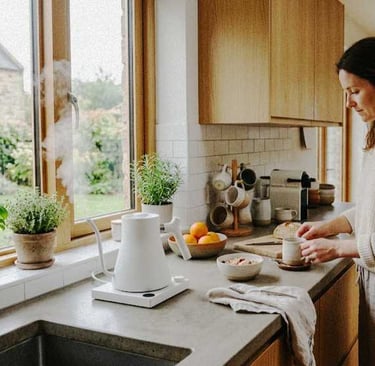
A small moment while the kettle boils — often all it takes to keep everyday clutter from building up.
© 2026 Oakwood Daily. All rights reserved.