The ‘Repeat Meal’ System That Makes Life Easier (Without Feeling Boring)
Tired of deciding what to cook every day? This simple repeat meal system reduces stress, saves time, and makes daily routines feel easier.
Noor Arin
Published at: 19/03/2026

What are we having for dinner?
It sounds small. It is not small. It carries the fridge, the budget, the clock, the preferences of everyone in the house, the thing defrosting too slowly, the vegetable that needs using, the fact that pasta happened yesterday, and the private knowledge that nobody wants to think very hard anymore.
The cooking is not always the problem. Cooking has edges. Chop this. Heat that. Stir. Taste. Serve. The harder part often comes before the pan is on the hob, when the evening still has no shape and someone is standing in front of the fridge as if it might offer counsel.
Inside: half a pepper, a tub of yoghurt, two eggs, a jar of pesto, something wrapped in foil whose purpose has become unclear. The light is too bright. The door is open too long. A person can lose a surprising amount of hope in front of a vegetable drawer.
This is where variety begins to look less like pleasure and more like work.
Weeknight dinner now carries a strange burden. It should be quick, reasonably healthy, affordable, not boring, not too repetitive, acceptable to whoever is eating, and ideally made without generating a sink full of pans. Repetition, meanwhile, has acquired an undeserved shame. Pasta twice in a week can feel like evidence of defeat.
Usually it is just evidence of a week.
The answer is not a perfect meal plan. Perfect meal plans belong to imaginary households where Thursday behaves as predicted. Real Thursdays run late. Someone forgets to buy onions. Nobody wants the thing that made sense on Sunday. The spinach has collapsed into itself. The freezer, suddenly, becomes a moral resource.
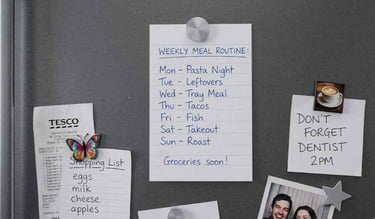
What works better is a looser rhythm: a few familiar shapes the week can fall into without much negotiation.
A tray of vegetables and sausages. Pasta when the day has gone sideways. Rice with whatever can sit on top of it. Eggs when nobody has the will for ceremony. Soup, toast, noodles, leftovers, something pulled from the freezer and treated with respect.
The point is not to eat the same dinner every week. It is to stop beginning from nothing.
“Pasta night” is not a recipe. It is a narrowed field. Tomato sauce if there is time. Pesto if there is not. Butter, garlic, and parmesan if the fridge has entered its sparse, end-of-week mood. The category holds steady; the meal changes inside it.
That small constraint can feel oddly generous. It removes the most tiring part of the process: the open-ended question. Instead of inventing dinner, you are choosing a version of something the house already understands.
Shopping becomes less theatrical too. You stop buying ingredients for seven unrelated ambitions and begin keeping the bones of dinner nearby: pasta, rice, eggs, tins, freezer backups, vegetables that can roast without complaint, one or two things that make a tired evening feel less grim. There will still be duplicate yoghurt. There will still be a bag of leaves discovered too late. But the week has a rough architecture now.
This is not about discipline. Discipline is too brittle for dinner.
It is about lowering the number of decisions required at the worst part of the day. The hour when everyone is hungry is a poor time to ask for imagination. Better to have a few routes already worn into the week.
A household does not need every meal to be interesting. Interesting is a heavy demand to place on a Tuesday.
Some dinners are there to nourish. Some are there to use up what is left. Some are there because the day was long and people still need feeding.
That is enough.
The quiet success of a repeat-meal rhythm is that dinner stops presenting itself as a fresh problem each night. It becomes part of the house’s muscle memory: not glamorous, not rigid, simply available.
The relief is not in eating the same thing.
It is in no longer having to invent an evening from scratch.
A simple weekly rhythm—less thinking, fewer decisions, and dinners that just work.
© 2026 Oakwood Daily. All rights reserved.